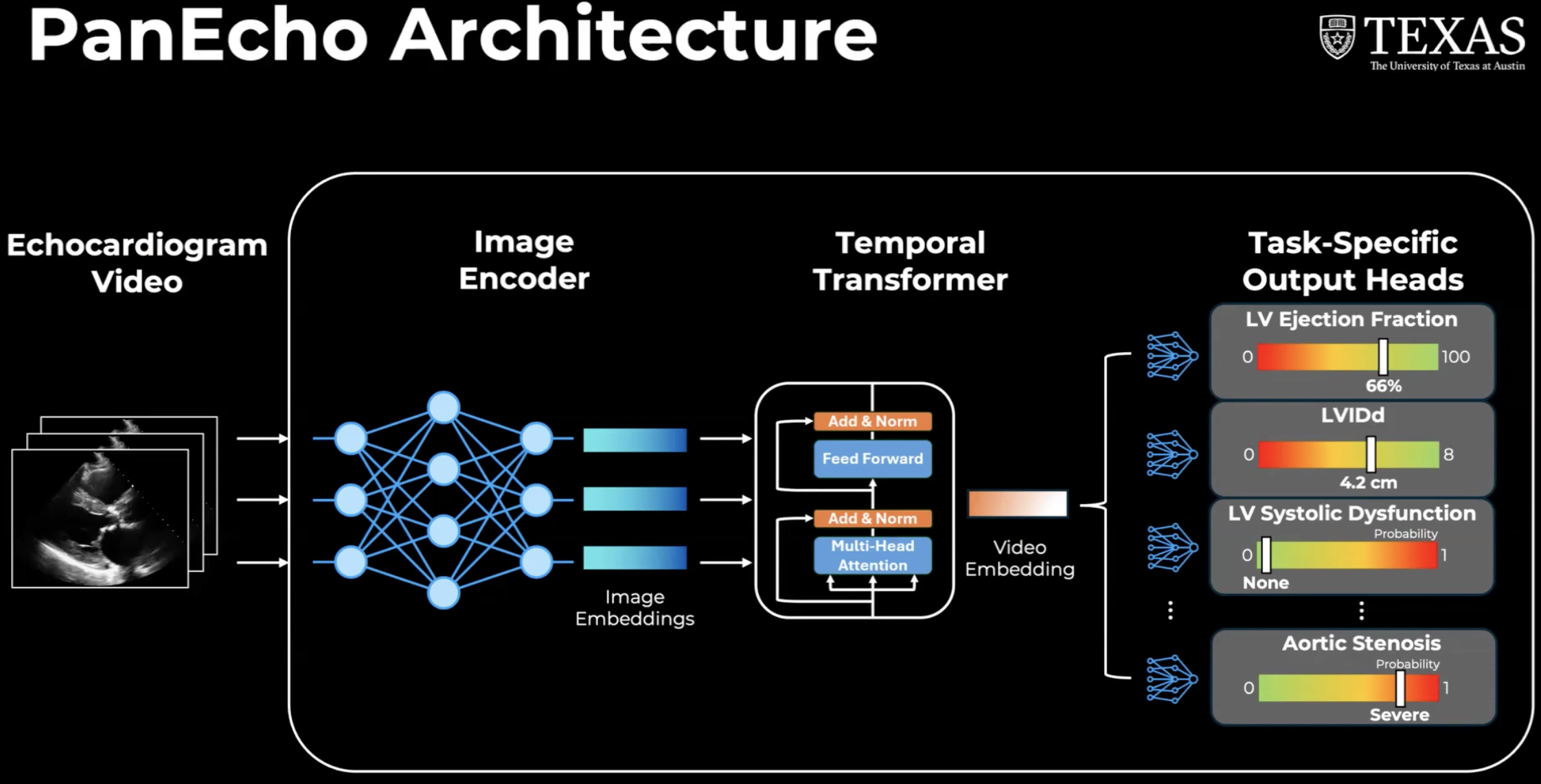
This post is a code-focused deep dive into an echocardiographic deep learning model called PanEcho. PanEcho is a multivew, multitask, and video-based deep learning model capable of performing 39 diverse interpretation tasks. PanEcho consists of a 2D image encoder, temporal transformer, and output heads dedicated to the 39 individual tasks.
PanEcho processes an echocardiogram video — a sequence of frames — and turns it into predictions for 39 clinical tasks. The model does this in four stages:
Per-frame feature extraction: Each video frame is passed independently through the 2D image encoder, an ImageNet-pretrained ConvNeXt-Tiny CNN. The image encoder compresses each frame into a single 768-dimensional feature vector summarizing the spatial content visible in that frame. Temporal dynamics across frames are then modeled separately by a 1D temporal Transformer over the sequence of frame embeddings.
Adding temporal order: The image encoder treats each frame in isolation, so the model has no inherent sense of which frame came first. To restore this, the frame’s position in the sequence is encoded with a sinusoidal positional encoding and added elementwise to its feature vector.
Modeling relationships across frames: The position-aware feature vectors are fed into a Transformer encoder of four layers, each with eight self-attention heads. Self-attention lets every frame attend to every other frame, so the Transformer can model temporal dynamics across the whole clip — for example, how the heart wall moves between systole and diastole — and produces a refined, context-aware feature vector for each frame.
Pooling and prediction: The refined frame-wise vectors are aggregated into a single video-level representation by mean pooling (averaging across the frame axis). This one vector is fed to each of the task-specific output heads. Every head consists of a Dropout layer followed by a fully-connected layer that produces that task’s prediction.
In the rest of this post, we will go through the source code of the FrameTransformer class, the MultiTaskModel class, and the PanEcho model listed on the PyTorch Hub. The FrameTransformer class specifies the architecture involving the 2D image encoder and 1D temporal Transformer. The MultiTaskModel class defines the multitask learning component, combining the frame-level features with task-specific heads to produce the final predictions. Finally, we will run the PanEcho model on a sample from a public dataset, EchoNet-Pediatric, to see it in action.
The FrameTransformer class
The FrameTransformer class implements the 2+1D architecture with the 2D image encoder and 1D temporal Transformer for echocardiography video modeling. The __init__ method initializes the architecture with the specified parameters.
The __init__() method
The FrameTransformer class uses the ImageEncoder class to define a 2D image encoder. The ImageEncoder class dispatches depending on the arch argument, which defines the intended architecture, such as ResNet, ConvNeXt, or Swin. For the PanEcho model, we use the ConvNeXt Tiny model architecture. Then, it records the size of the original classification layer’s input and replaces the classification layer with torch.nn.Identity().
Also, the FrameTransformer class builds one Transformer encoder layer (transformer_encoder) with the following parameters:
d_model: The dimension of the input and output feature vectors, which is set to the number of features output by the image encoder (self.encoder.n_features).
nhead: The number of attention heads in the multi-head attention mechanism. d_model is split across heads.
dim_feedforward: The dimension of the feedforward network within the Transformer encoder layer, which is also set to self.encoder.n_features.
dropout: The dropout rate applied to the output of the feedforward network and the attention mechanism, specified by the transformer_dropout parameter.
activation: The activation function used in the feedforward network.
batch_first : Indicates that the input and output tensors are expected to have the batch size as the first dimension.
Then, we form a full Transformer encoder by stacking num_layers of these transformer_encoder layers. This allows the model to learn complex temporal relationships in the echocardiography video data.
The model’s classifier is set to torch.nn.Identity(), which means it will simply return the output of the Transformer without applying any additional transformations.
self.time_encoder is initialized as an instance of the PositionalEncoding class, which will be used to add positional information to the feature vectors before they are passed through the Transformer. The max_len parameter is set to clip_len, which indicates the maximum length of the input sequence (number of frames in the video clip) that the model can handle. This allows the model to learn temporal relationships between frames in the echocardiography video.
Show code
class FrameTransformer(torch.nn.Module):"""2+1D architecture with 2D image encoder and 1D temporal Transformer for echocardiography video modeling."""def__init__(self, arch, n_heads, n_layers, transformer_dropout, pooling, clip_len=16):super(FrameTransformer, self).__init__()self.pooling = poolingself.encoder = ImageEncoder(arch) transformer_encoder = torch.nn.TransformerEncoderLayer( d_model=self.encoder.n_features, nhead=n_heads, dim_feedforward=self.encoder.n_features, dropout=transformer_dropout, activation='relu', batch_first=True, )self.transformer = torch.nn.TransformerEncoder( transformer_encoder, num_layers=n_layers )self.classifier = torch.nn.Identity()self.time_encoder = PositionalEncoding( d_model=self.encoder.n_features, dropout=0, max_len=clip_len )
The forward() method
The forward() method takes an input tensor x of shape (batch_size, channels, clip_len, height, width) and processes it as follows:
The input tensor is reshaped to (batch_size * clip_len, channels, height, width) to ensure the correct dimensions for processing and then passed through the image encoder to extract features from each frame. The output shape of the image encoder is (batch_size * clip_len, n_features).
After reshaping to (batch_size, clip_len, n_features), the positional encoding is added to the feature vectors to incorporate temporal information. The resulting tensor is then passed through the Transformer encoder to model the temporal relationships between frames. The output of the Transformer is shaped (batch_size, clip_len, n_features) - e.g. (2, 16, 1024).
Temporal pooling step is applied by computing the mean along axis 1 (the frame axis), which averages across all 16 frames and removes that dimension. This results in a tensor of shape (batch_size, n_features), - e.g. (2, 1024) giving us a single feature vector for each video clip.
Finally, the output of the Transformer is passed through the classifier (which is an identity function in this case) to produce the final output.
Show code
def forward(self, x): b, c, l, h, w = x.shape# x: batch_size x 3 x clip_len x h x w x = x.reshape(b*l, c, h, w) # batch_size*clip_len x 3 x h x w embeddings =self.encoder(x)# embeddings: batch_size x clip_len x n_features embeddings = embeddings.reshape(b, l, self.encoder.n_features) embeddings =self.time_encoder(embeddings) feats =self.transformer(embeddings)ifself.pooling =='mean': pooled_feats = feats.mean(1)elifself.pooling =='mean-max': mean_pooled_feats = feats.mean(1) max_pooled_feats, _ = feats.max(1) pooled_feats = torch.cat([mean_pooled_feats, max_pooled_feats], dim=1)else:import sys sys.exit(-1) out =self.classifier(pooled_feats)return out
The MultiTaskModel class
The MultiTaskModel class is the top-level PanEcho model. It takes the shared video encoder (the FrameTransformer class) and attaches one prediction head per clinical task. As a result, a single forward pass produces multiple outputs. The __init__ method initializes the MultiTaskModel class with the specified parameters.
The __init__() method
The MultiTaskModel class creates a head for each task, consisting of a Dropout and a Linear layer. The output width depends on whether the task type is binary classification or regression or multi-class classification:
Binary classification or regression: A head that maps encoder_dim-wide feature vector to a single output (1 output). Then, it sets the bias of the head’s final Linear layer to that task’s training-set mean value to account for different scales.
Multi-class classification: A head that maps encoder_dim-wide feature vector to one output per class. (task.class_names.size outputs)
Show code
class MultiTaskModel(torch.nn.Module):"""Multi-task model with shared video encoder and separate prediction heads for each clinical task."""def__init__(self, encoder, encoder_dim, tasks, fc_dropout=0, activations=True):super().__init__()self.encoder = encoderself.tasks = tasksself.activations = activationsfor task inself.tasks:if task.task_type =='multi-class_classification':self.add_module( task.task_name +'_head', torch.nn.Sequential( torch.nn.Dropout(p=fc_dropout), torch.nn.Linear(encoder_dim, task.class_names.size), ), )else: # binary classification or regression, both have 1 outputself.add_module( task.task_name +'_head', torch.nn.Sequential( torch.nn.Dropout(p=fc_dropout), torch.nn.Linear(encoder_dim, 1), ), )# Initialize bias term to training set mean value# (to account for different scales/units) head =self.get_submodule(task.task_name +'_head') head[-1].bias.data[0] = task.mean
The forward() method
In the forward method, we run the input through the shared video encoder (FrameTransformer class) to get a feature vector (batch_size, encoder_dim) and then pass that feature vector through each task’s prediction head, then run an activation function to get the output for that task. The outputs for all tasks are collected and returned.
Show code
def forward(self, x): x =self.encoder(x) out_dict = {}for task inself.tasks: out =self.get_submodule(task.task_name+'_head')(x)ifself.activations:if task.task_type =='binary_classification':# Ensure that output corresponds to "positive" class# for all binary classification tasks inverted_tasks = ['MVStenosis','AVStructure','RASize','RVSystolicFunction','LVWallThickness-increased-modsev','LVWallThickness-increased-any','pericardial-effusion', ]if task.task_name in inverted_tasks: out_dict[task.task_name] =1- torch.sigmoid(out)else: out_dict[task.task_name] = torch.sigmoid(out)elif task.task_type =='multi-class_classification': out_dict[task.task_name] = torch.softmax(out, dim=1)else: out_dict[task.task_name] = outelse: out_dict[task.task_name] = outreturn out_dict
PanEcho on Torch Hub
The PanEcho repo contains a hubconf.py file that imports the classes built in models.py and provides a ready-to-use model with the PanEcho() function.
First, it initializes the PanEcho architecture with the constructor arguments that FrameTransformer expects. The architecture of the image encoder is set to convnext_tiny, the number of Transformer layers is set to 4, the number of attention heads is set to 8, the pooling method is set to mean, and the dropout rate for the Transformer is set to 0 (no dropout).
Show code
# Load taskstask_dict = pd.read_pickle('https://github.com/CarDS-Yale/PanEcho/blob/main/content/tasks.pkl?raw=true')all_tasks =list(task_dict.keys())task_list = [ Task( t, task_dict[t]['task_type'], task_dict[t]['class_names'], task_dict[t]['mean'], )for t in all_tasks]
Then, it loads a file containing the definitions of all the clinical tasks that PanEcho is designed to predict. Each task is represented as an instance of the Task class, which includes the task name, type (e.g., binary classification, multi-class classification, regression), class names (if applicable), and mean value (for regression tasks).
Then, it initializes the shared video encoder (FrameTransformer class) with the specified architecture parameters and creates an instance of the MultiTaskModel class, passing in the shared video encoder, its output feature dimension (encoder_dim), the list of tasks, a dropout rate of 0.25 for the fully connected layers in the prediction heads, and whether to apply activation functions to the outputs.
Finally, it loads the pretrained weights from the PanEcho GitHub repo. The weights are stored in a dictionary, and we extract the ‘weights’ key to get the actual state dictionary for the model. Then, we remove the fixed positional encoding weights (encoder.time_encoder.pe) from the state dictionary to allow for variable clip lengths during inference. Finally, we load the remaining weights into the model using model.load_state_dict(weights, strict=False), which allows for missing keys (like the removed positional encoding) without raising an error.
Quick Demo
In the last section of this blog post, we will demonstrate the PanEcho model in action with a sample from the EchoNet-Pediatric dataset. The dataset consists of 3,176 apical-4-chamber echocardiography (A4C) videos and 4,424 parasternal short axis echocardiography (PSAX) videos from individuals who underwent imaging between 2014 and 2021 as part of routine clinical care at Lucile Packard Children’s Hospital at Stanford.
The PanEcho paper evaluates the model on several large echocardiography datasets, including EchoNet-Dynamic and EchoNet-LVH. For this demo, however, we will use EchoNet-Pediatric, since it is the smallest of these datasets and fits comfortably on a local machine.
First, we download the EchoNet-Pediatric dataset from the Stanford Artificial Intelligence in Medicine and Imaging (AIMI) Center Shared Datasets Portal, which consists of the A4C/ and PSAX/ view folders. Then, we load the metadata (one row per video) and the task definitions, keeping just EF (ejection fraction). The reason for keeping just EF is that the EchoNet-Pediatric dataset is particularly focused on it. Then, we build the dataset with the EchoNetPediatricDataset class.
Finally, we load the PanEcho model from Torch Hub and run it on a sample from the EchoNet-Pediatric dataset.
Show code
# Demo for Blog postimport osimport torchimport pandas as pdimport numpy as npfrom hubconf import Taskfrom src.dataset import EchoNetPediatricDatasetfrom src.models import PositionalEncoding, ImageEncoder, FrameTransformer, MultiTaskModel# Parent dir that contains the A4C/ and PSAX/ view folders.# EchoNetPediatricDataset reads videos from <data_dir>/<VIEW>/Videos/<FileName>.data_dir ="."# --- Load + assemble metadata (one row per video), mirroring train_echonetpediatric.py ---a4c_df = pd.read_csv(os.path.join(data_dir, "A4C", "FileList.csv"))a4c_df["acc_num"] = a4c_df["FileName"].apply(lambda x: x.split("-")[1])a4c_df["view"] ="a4c"psax_df = pd.read_csv(os.path.join(data_dir, "PSAX", "FileList.csv"))psax_df["acc_num"] = psax_df["FileName"].apply(lambda x: x.split("-")[1])psax_df["view"] ="psax"data_df = pd.concat([a4c_df, psax_df], axis=0).reset_index(drop=True)data_df = data_df.rename(columns={"Split": "fold"}) # 'Split' holds the 0-9 cross-val fold ID# --- Load task definitions and keep just EF (the pediatric target) ---task_list = np.load("content/tasks.npy", allow_pickle=True)task_list = [t for t in task_list if t.task_name =="EF"]# --- Build the dataset for one cross-validation fold/split ---train_dataset = EchoNetPediatricDataset( data_dir=data_dir, data_df=data_df, tasks=task_list, split="train", # 'train' | 'val' | 'test' fold=0, # which of the 10 folds is held out as test (val = fold+1) clip_len=16, num_clips=4, augment=True, # train-time augmentations; set False for val/test normalization="",)print(f"Dataset size: {len(train_dataset)}")# Fetch one sample to verify it workssample = train_dataset[0]print({k: (v.shape if torch.is_tensor(v) else v) for k, v in sample.items()})x = sample["x"]x = x.unsqueeze(0)xmodel = torch.hub.load('CarDS-Yale/PanEcho', 'PanEcho', force_reload=True)model.eval()with torch.no_grad(): output = model(x)output
We get an output of EF = 45.8655, meaning that the ejection fraction is predicted to be approximately 45.9%. This shows that the model predicted that ~45.9% of the blood in the left ventricle is ejected per contraction.